
Six weeks on a human trafficking pilot in Tanzania
Isabella Tang helped design a pilot on religious leaders and human trafficking, and met with organizations that support survivors.
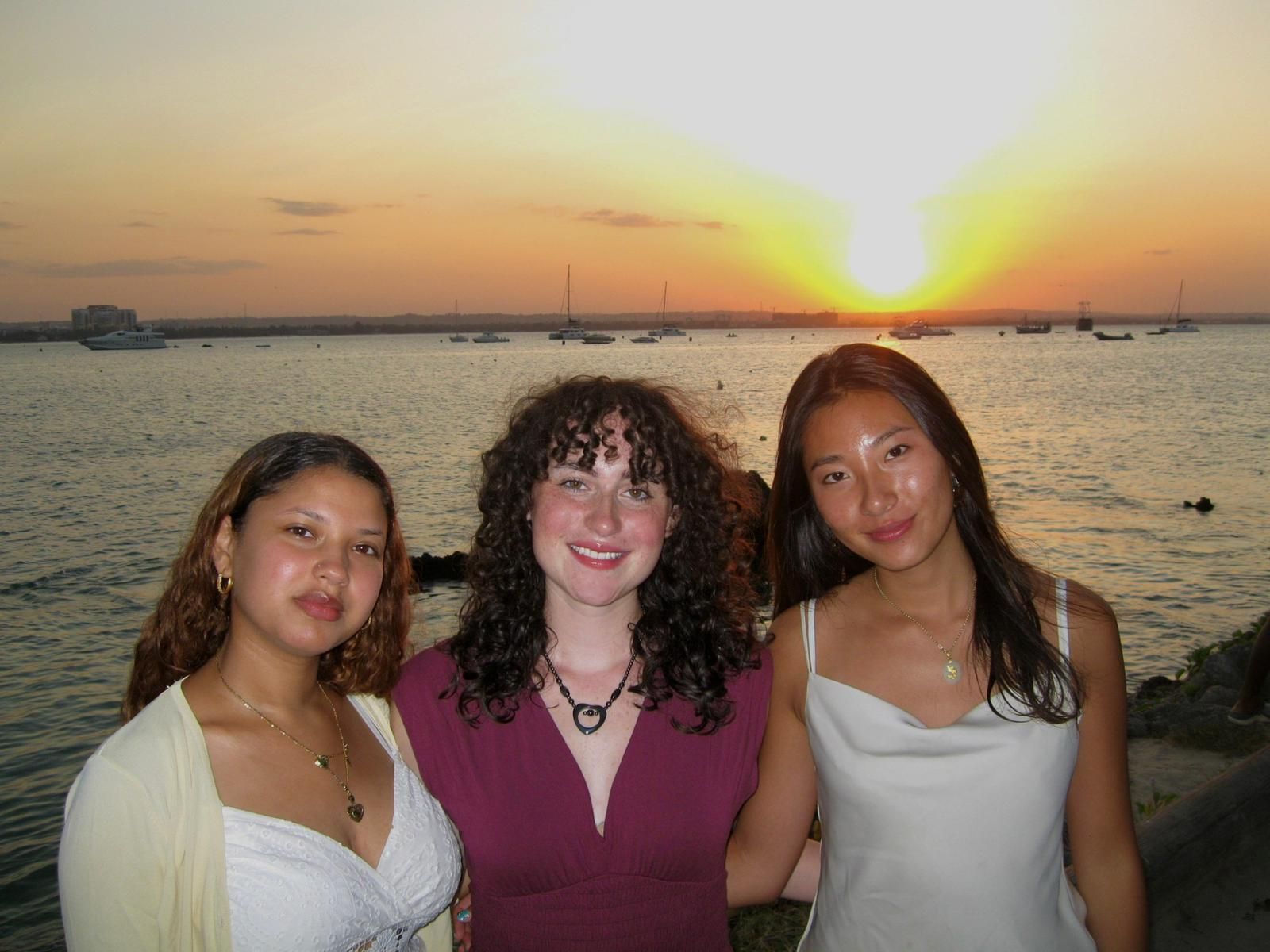
Despite arriving in Dar Es Salaam at 5 AM after a 20+ hour journey, my excitement for my time in Tanzania only grew as Alex, Saira, and I were greeted with open arms by a beautiful Tanzanian sunrise and Zakayo, a long-time friend of Professor Groves and the Head of Knowledge Management and innovations at ESRF, the organization where I would be interning this summer as an Economic and Social Research Intern.
My curiosity about the process of research and how it contributes to policy-making led me to Tanzania. A pilot-phase randomized controlled trial (RCT) to combat human trafficking was introduced to me towards the end of my sophomore year by Beatrice Montanto, Salma Emmanuel, and Dylan Groves. Most of the research I have participated in involved gathering and analyzing existing writings, but I’ve always been interested in how the works came to be. I ended up devoting the majority of my time to this project. Additionally, I’m interested in understanding the collaboration between evidence-based research and national governments in pushing legislature toward specific directions. The Economic and Social Research Foundation (ESRF), an independent policy research think tank devoted to improving and evaluating Tanzania’s economic management and capacity development, has helped me answer many of my questions.
As an intern, I assisted ESRF staff with ongoing projects, which introduced me to the components and skills required for field research. Afya Yako, one of ESRF’s large-scale projects, works to assess whether local accountability journalism can enhance the bureaucratic implementation of health service delivery. I used QGIS mapping to identify clinics within a radio transmission radius, participated in and helped draft the manual and quiz for enumerator training, and sorted through collected facility data. Attending the 12th annual African Evidence Summit, I learned about RCTs done to advance evidence-informed development policy by local and foreign scholars across SSA. Presentations that stuck with me included Pascaline Dupas’s “Intergenerational Effects of Secondary Education in Ghana” and Monica Lambon-Quayefio’s “Access to Digital Credit for Smallholder Farmers: Experimental Evidence from Ghana.” Having just taken Econometrics last semester, it was so exciting seeing the importance of the subject come to life.
Helping ESRF also gave me the perfect introduction to various areas of policy prioritized by Tanzania. Reviewing local research grant proposals exposed me to conversations surrounding issues ranging from microfinancing to pollution, from infant mortality to education technology. During Researchers on Wednesdays, staff were briefed on government priorities and budgets and discussed how to assist such objectives like job creation, increasing productivity and production, and decreasing relative costs.
Although unfamiliar with the topic of human trafficking, I was eager to explore the issue as it shares many similarities with an area of work I am involved in: domestic violence. The research team was so quick to help me get acquainted before my internship, introducing me to previous research, evidence reviews and background information, reports from US and Tanzania authorities, and training required to engage in this research topic (IoM and CITI certifications). The project aims to (1) explore how religious leaders can influence knowledge, attitudes, norms, and behaviors related to human trafficking and (2) support the reintegration of trafficking survivors by reducing the stigma faced by trafficking survivors in Tanga, Tanzania.
Involved with the early stages of the project, I helped draft COSTECH (Tanzania Commission for Science and Technology) and Lafayette IRB (Institutional Review Board) proposals, pre and post-intervention surveys measuring norms and attitudes through SurveyCTO, and MoU (Memorandum of Understanding) and PA (Partnership Agreements) with project partners. Throughout the process of brainstorming how to structure and draft the awareness-raising materials for Muslim and Christian leaders to disseminate to community members and at-risk youth, my priority is to learn the most about previous research conducted. I found reviewing academic articles interesting but preferred learning through conversations with local non-governmental organizations. One of the first meetings I sat in on was a performance screening, in collaboration with the University of Dar Es Salaam drama department, used to advocate for nutrient balance in local diets. It was then that I quickly caught on to the collaborative nature of work done toward improving the country.
The research team’s supportive culture was particularly helpful whenI decided to reach out to local human trafficking organizations, who were much more familiar with the subject than the research team was. Following my first introductory meeting with the Tanzania Relief Initiative/Tanahut with Professor Groves, I arranged a second meeting, this time on behalf of ESRF. Not only does developing a network of human trafficking organizations in Tanzania benefit the project, but it also builds the foundations for future collaborations. At ESRF, this human trafficking project is the first of its kind, but I’m sure not the last. Tanahut has already agreed to provide basic human trafficking training to ESRF staff and invited ESRF to a commemoration of World Day Against Human Trafficking.
The people I met, especially Tanahut and Courage Worldwide, made it possible for me to speak to trafficking survivors. I began by reaching out to Mr. Edwin Mugambila, a lawyer and the Executive Director of Tanahut, to gain an insight into how human trafficking manifests in Tanzania and to access the extensive network of NGOs working towards trafficking in person prevention. This led me to visit Courage Worldwide in Dar Es Salaam, where, after extensive conversations with multiple staff members, I was able to set up interviews with sex-trafficked girls in Moshi. Hearing their experiences and their feedback on our project built additional background information and ensured the training we develop is narrowly tailored to address human trafficking in Tanzania. Along with many other findings, our team learned we made many assumptions that restricted what human trafficking encompassed and failed to acknowledge the cultural norms’s impact on survivor reintegration. It was a 20th birthday well spent. Without time constraints, I would’ve loved to interview survivors rehabilitated in Dar Es Salam with the help of Community Health and Social Welfare Africa.
I hope this pilot will bring a potential path to achieving the long-term objective of combating the trafficking of children for forced labor and sexual work in Tanzania, an initiative I will continue to contribute to following the conclusion of my time in the country.
Being in Tanzania for the first time, I also wanted to live a fulfilling summer outside of the office. The best way to understand Tanzania is through experiencing its lifestyle, culture, history,and food. From the first of many Bajaji rides to the office to meeting the ESRF team, I remember my first week in Tanzania being full of new experiences. Such adventures would continue to follow me throughout my trip, some more enjoyable than others—I wouldn’t say the hospital was my favorite destination.
Adjusting to a country on a foreign continent wasn’t easy, to say the least—food poisoning, tourist harassment, and general travel anxiety are not uncommon. However, it helped that I was with a group of peers and mentors there to guide me. Fortunately, I had people who took care of me when I was sick (three times!).
With the advice of Marco and Zakayo, we successfully took the purple Kawe Daladala (the primary local form of transportation) to Saba Saba Day — a celebration of unification and trade — where we got to meet vendors from all across Africa. It seemed like a piece of cake after we took a much more complex route up to the historic town of Bagamoyo, once chosen as the capital of German East Africa. We visited the multi-ethnic Mji Mkongwe (Stone Town) in Zanzibar, where you can see the remainder of Arabia, India, and European influences in its cuisine and architecture. Our trip to the National Village Museum and Pugu forest hike, which included the worship cave of the Wazaramo people, taught us about the numerous tribes that inhabit Tanzania and their traditions.
We learned how to bargain over Kanga (traditional pattern fabric) at the largest market in Tanzania, Kariakoo, where we also mastered the phrase hapana asante (No, thank you). I am proud to say I saved 10,000 TZS (around 3 dollars). I got to see 3 out of the “Big 5” animals (Elephant, African Buffalos, and Lions) at Mikumi National Park. But waking up at 4 AM and the 6-hour drive was nothing compared to my 11-hour bus ride to Moshi. My favorite was the Amapiano mixes blasting the whole way. I got to see Mount Kilimanjaro, which didn’t even look real up close, interviewed human trafficking survivors (details in a separate blog), and hiked the muddy, slippery Materuni waterfalls with Brenda.
Don’t even get me started on the food. The local cuisine never failed to impress, from the flavor to the variety. I can see why after seeing the cloves, cinnamon, cardamom, turmeric, ginger, and pepper that go into cooking during our spice tour in Zanzibar. The best wali maharage (rice and beans) in town can be found at our regular lunch spot right off the side of Uporoto Street. My personal preference is to have it with a side of pili pili sauce (pepper sauce) and fresh coconut water. KukuKuku (chicken chicken) has a special place in my heart, especially the mchuzi tatu (three sauce) chicken patties with a side of chapati I had for my last meal in Tanzania. The nyama (meat), ndizi, (banana) pilau (seasoned rice) platter we had after our hike in the Pugu forest whose flavor was accentuated by our hunger from not having breakfast before our climb. I had the best fresh-caught fish and lobster by the beautiful beach of Mbudya Island, a 30-minute boat ride from the mainland. Honorable mention to WZW, run by a lovely lady who gave me free tomato egg soup when I had the stomach flu, where we interns, located 2 minutes walking distance from the restaurant, were easily their #1 customer.
I leave Tanzania missing its people. The first thing we learned about Swahili is greetings, and in Swahili culture, greetings aren’t merely a formality but a conversation that establishes meaningful connections between strangers. Although slightly different in meaning, no matter whether you can start a conversation with Mambo, Shekamoo, Mzima, Karibu, or Habari, there is always a response from a place of value and respect. I also saw the similarities between my Chinese family and Tanzania’s strong emphasis on family, which comforted me being so far from home. Witnessing the warmth and joy of family gatherings when having dinner with Brenda (ESRF staff) and her extended family on my birthday was one of my favorite nights spent in Tanzania.
Being the last one to leave Tanzania, it took me around 2 hours to say goodbye to everyone who was not only my coworkers but became my friends. It’s difficult to leave people when you know you still have much to learn from them. To others that are considering similar journeys, my advice to you is to soak it all in because the weeks will fly by and remember to take your malarone and doxycycline on time. This was truly an eye-opening experience and asante sana to everyone who made this journey possible and memorable!